
You finally decided to travel to Jordan? Good job! After getting the biggest decision out of the way, you’re all set to get into the nitty-gritty travel planning that we all love and look forward to.

Let’s find out what Jordan’s climate is all about, when it is best for you to visit Jordan and how that will impact the packing you will do for this trip.
| 3 Things to know about Wadi Rum weather: |
| 1. While the North-West of Jordan is dominated by a Mediterranean Climate, the South is ruled by a harsh desert climate. 2. During summer, the Wadi Rum desert experiences temperatures of up to 40 degrees Celsius (104 degrees Fahrenheit). 3. The best times to visit are the months of spring and fall where temperatures drop significantly and allow for activities such as hiking, trekking and climbing. |

Visit Wadi Rum.
Book that flight deal, pack your seven things and visit Wadi Rum. All throughout the year, Wadi Rum is a unique and picturesque location waiting to be explored by you. Contract our guides to make the best of your experiences.
- Visit Wadi Rum.
- Jordan Weather and Climate in General
- 5 Things You Need to Know before You Visit Wadi Rum
- Wadi Rum Weather and Climate – An Overview
- Where to Stay and What to do in Wadi Rum in the Summer months
- Where to Stay and What to do in Wadi Rum in the Winter months
- FAQs
Jordan Weather and Climate in General

Jordan is located in the heart of the Middle East. The country, while almost being landlocked, enjoys a Mediterranean climate in the North-West and a desert climate in the East and the South. Its temperatures range from 9-13 degrees Celsius (48-55 degrees Fahrenheit) in the North and 19-22 degrees Celsius (66-71 degrees Fahrenheit) in the South.
Summers in Jordan a very hot with the Jordan Valley, including tourist sight such as the Dead Sea, reaching temperature beyond 40 degrees Fahrenheit (104 degrees Fahrenheit). Therefore, few tourists venture out to visit Jordan during the peak of summer. Other seasons not only bring less daylight hours, but also partly cloudy skies and occasional rain.
5 Things You Need to Know before You Visit Wadi Rum
There is a few things you should be aware of before visiting Wadi Rum specifically:
- Pack Sun Protection (Always): The Wad Rum desert in the South of Jordan gets a lot of sunlight year round. Always make sure to bring a head cover and enough sunscreen to protect your skin.
- Pack a Jacket (Especially in Winter): While days in Wadi Rum tend to be hot, nights in the desert are fresh, to say the least. This is especially true for the winter months. Therefore, make sure to pack a warm jacket.
- Get the Jordan Pass: Wadi Rum is classified as a Protected Area. Therefore, you will be asked to pay a fee at the Wadi Rum Visitor Center. Getting the Jordan Pass will waiver this fee among others.
- Stay in a Bedouin Camp: To get the most authentic Bedouin experience of Wadi Rum, we highly recommend you to book a stay in one of the Bedouin desert camps.
- Book Wadi Rum Experiences in Advance: No matter what you want to do in Wadi Rum, you will need to book a tour beforehand. This is because of the big distances between sights and limited mobility in the desert.
Wadi Rum Weather and Climate – An Overview

The Wadi Rum desert is dominated by a hot and arid desert climate that allows for little vegetation and limited life. It is, however, divided into different seasons that bring varying conditions to the desert in the South of Jordan.
Spring is fairly warm with 26 degrees Celsius (79 degrees Fahrenheit) at day and fairly cold nights. Occasional rainfall allows for more vegetation such as wildflowers. Tourists prefer to come in this season.
Summer follows and brings the heat – up to 40 degrees Celsius (104 degrees Fahrenheit) and the most daylight hours. It is almost without exception sunny and sandstorms should be expected. Nights are, again, fair.
Fall (Autumn) brings a decrease in temperatures. At daytime, temperatures go up to 25 degrees Celsius (77 degrees Fahrenheit). Tourists prefer to come in fall to partake in outdoor activities such as hiking, trekking, climbing and sandboarding.
Winter brings colder temperatures with January being the coolest month out of the year. Days only receive temperatures of around 15 degrees Celsius (59 degrees Fahrenheit) and a minimum temperature at night of only 2 degrees Celsius (35 degrees Fahrenheit). Winter also brings the bulk of the on average 15 days of rainfall in the desert.
How to Beat the Summer Heat
The summer heat is strongest during – drum roll – the spring and summer months. In the months of May, June, July, August and September you can expect hot temperatures soaring up to 40 degrees Celsius (more than 104 degrees Fahrenheit) – the maximum temperature of the Wadi Rum desert. Dry winds, clear skies and sandstorms dominate the climate in summer.
The desert heat can be overwhelming for some, with the morning shade, the occasional gust of wind and lots of water being the only cure to the heat. Make sure to bring appropriate clothing such as head covers and pack enough sunscreen. Only in late September, the average temperature in the desert drops down to what most will describe as bearable conditions to visit Wadi Rum.
That being said, there is still plenty of tourists venturing out to Wadi Rum in summer. Summer nights in the desert still provide fair temperatures and tours are usually held in the early mornings and late evenings to avoid the mid-day heat. While relaxing at noon, you can opt to explore some of the valleys as the day progresses.
Visit Wadi Rum in Winter for Pleasant Temperatures
The best months to visit Wadi Rum are the winter months however. All throughout fall and winter, Wadi Rum receives a much fairer climate, with colder temperatures, rainfall and partly cloudy skies. In winter, even snow fall can occasionally be seen in Wadi Rum.
The months of October, November, December, January, February, March and April are therefore regarded as the best time to visit the desert. In these months, along with tours, you will face to best conditions to scale the sand dunes, embark on hikes and go rock climbing, making it the best time to visit Wadi Rum.
During the winter season, it is more so the cold that you should worry about than the heat. Nights in the desert can become properly cold, making you want to pack an extra jacket. But don’t worry, Bedouin camps are also equipped with extra blankets.
Where to Stay and What to do in Wadi Rum in the Summer months

During the summer months, temperatures range pretty high, making you want to invest in a proper place to stay in the desert. Booking your hotel or camp, make sure to pick an accommodation with air conditioning to bare with the mid-day heat easily.
As for activities, don’t put your health at risk during your visit to Wadi Rum. If you are looking to get active, do so in the mornings and evenings. Otherwise, opt for Jeep tours, airballoon flights and camel rides.
Where to Stay and What to do in Wadi Rum in the Winter months
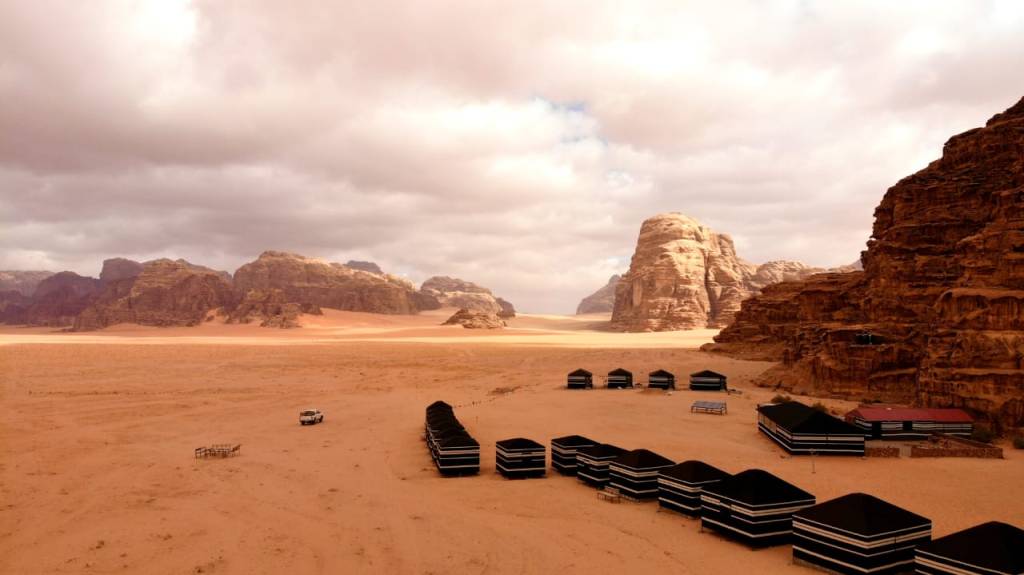
In winter, staying in a traditional Bedouin camp is by far your best choice. The traditional Bedouin tents will offer you all the comfort you will need and their secluded locations allow you to gaze at the stars without any light pollution.
As for activities, the winter months are the perfect time for you to get active. In Wadi Rum, you will have the chance to embark on hikes in the mountains, do trekking in the desert, go climbing and even try sandboarding.
FAQs
Does Wadi Rum get cold at night?
Yes, Wadi Rum does get quite cold at night year round. Especially in winter, you can expect the temperatures to drop as low as 2 degrees Celsius (35 degrees Fahrenheit). Make sure to pack an extra jacket and as your hosts for another blanket to stay warm at night.
Does it ever rain in Wadi Rum?
Yes, it does rain in Wadi Rum. Winter and spring bring 15 days of rainfall on average. This rainfall is crucial, feeling vegetation and filling up seasonal riverbeds, referred to as Wadis. In summer, rain is not to be expected in Wadi Rum at all.
What is the weather like in summer at Wadi Rum?
The desert climate of Wadi Rum is in full swing throughout the summer months of June, July and August. The weather is dominated by clear skies and hot temperatures of up to 40 degrees Celsius (104 degrees Fahrenheit). Few tourists come to visit Wadi Rum in summer.
When should I go to Wadi Rum?
The best time to visit Wadi Rum is the season of spring. Pleasant temperatures and a fair amount of vegetation dominate Wadi Rum, making for a comfortable stay. Many tourists also come in fall (autumn), taking advantage of the many daylight hours and comfortably warm temperatures.
What is the weather like in Wadi Rum camp?
The weather in Wadi Rum is dominated by a hot and arid desert climate. In spring, summer and fall, temperatures in Wadi Rum are fairly high, with winter offering colder temperatures and occasional rainfall. Nights in Wadi Rum tend to be colder.



 waditribe.com