

Your Jordanian travel itinerary is not complete without a camel ride? Fair enough. Camel riding, camel treks and camel safaris are ubiquitous in the Jordan Valley and Wadi Rum. But do camels even like being ridden?
| Camel Riding in a Nutshell: |
| 1. While camels can support heavy loads, wild camels do not like being ridden. 2. Domesticated camels do not mind being ridden as long as it is done in moderation and with proper equipment. 3. When booking a camel ride in Jordan, pay attention to our Ethical Camel Riding recommendations. |
As a counterweight to mass tourism, sustainable and ethical tourism has gained popularity in recent years. Animal welfare standards are continuously reevaluated and held to a higher standard. Gone are the days of naive elephant riding and camel trekking. And that is a good thing!
Experience Wadi Rum.
In Wadi Rum, Bedouin and camels make a living in a harsh desert environment. Dive into a unique landscape with an even uniquer culture. Book your worry-free desert experience with Wadi Tribe.
But is it possible to strike a balance between meeting animals and ensuring their welfare? These are our two cents on riding camels in Jordan.
- Experience Wadi Rum.
- Camels and Humans – A Century-Old Relationship
- Camel Riding and the Tourism Industry
- Is Riding Camels Possible in an Ethical Manner?
- 5 Tips & Tricks for Your Camel Ride as a Responsible Traveller
- Conclusion
- FAQs
Camels and Humans – A Century-Old Relationship

Camel herds are numerous in Jordan, more specifically herds of Arabian camels. These one-humped camels also go by the name of Dromedary camels, distinguishing themselves from the Bactrian camels that carry two humps.
In Jordan, there is an estimated wild population of some 14,000 wild camels. They are found mainly in the Jordan Valley in the West of Jordan as well as the further extent of the Wadi Rum Desert in Southern Jordan.
Camels are accustomed to arid environments. Their humps function as water storage allowing them to load up on water. They allow them to go without drinking for several days in the hot climate of the Arabian desert. Moreover, camels eat dry grass, grains and shrubs, making them well-accustomed to live in desert environments.
Long since, humans have come to realise the immense value of camels. In Jordan and the rest of the Middle East, camels have been domesticated for centuries, serving a number of purposes. Camels have been used in trade, transportation, milk production and also slaughtered for their meat. More recently, camels have also become a source of entertainment in the form of camel races and camel riding.
Camels and Bedouins – A Love Story
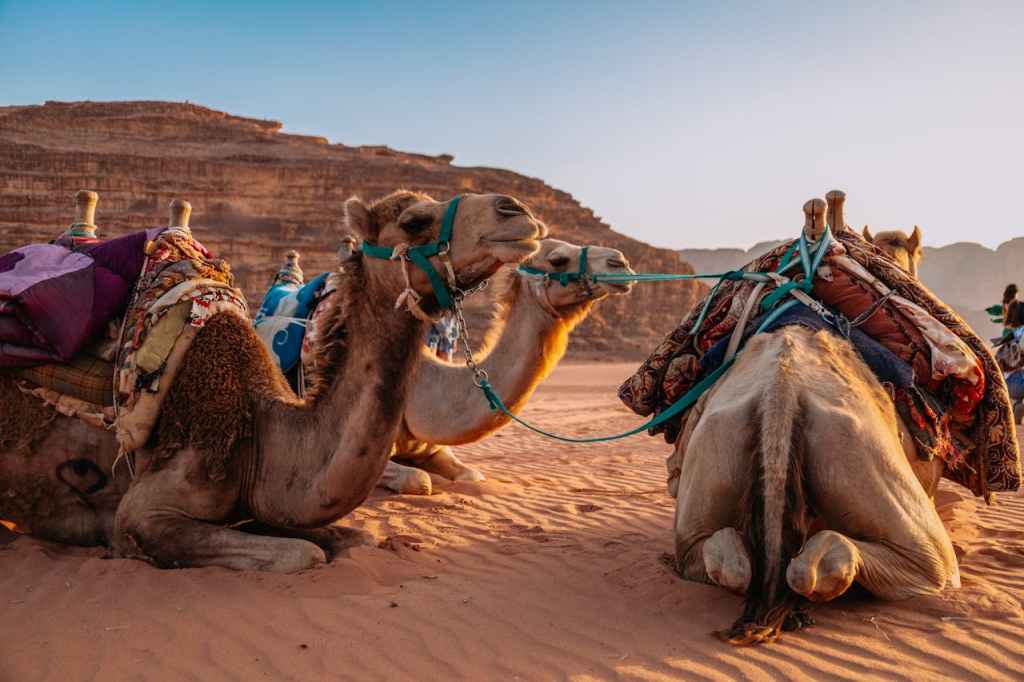
In Jordan, camels have been in use for well over 2,000 years. Petroglyphs in Wadi Rum attest the long relationship of humans and camels in arid environments. For the last centuries, it has been Bedouins in particular who have domesticated large numbers of camels.
In Bedouin culture, camels are not only useful, but also of high cultural importance. Camels are regarded the “pride and joy” of the Bedouin. Therefore, it is assumed that camels enjoy good treatment in Bedouin hands. Their cultural value is reflected in their use in ceremonies and high monetary value.
In Wadi Rum, camels are cared for in large enclosures enjoying solid nutrition and lots of off-time. As a visitor, you can see camels grazing all around the desert and restocking their water supply around Lawrence’s Spring. Local operators pride themselves of their good treatment of the animal. Rides are offered in moderation and at hours that suit the animal’s welfare.
However, recent challenges to semi-nomadic Bedouin life and the emergence of mass-tourism pose a challenge to animal welfare in Jordan. Animals start to be maltreated even in Bedouin environments due to a lack of education, resources or care.
Camel Riding and the Tourism Industry
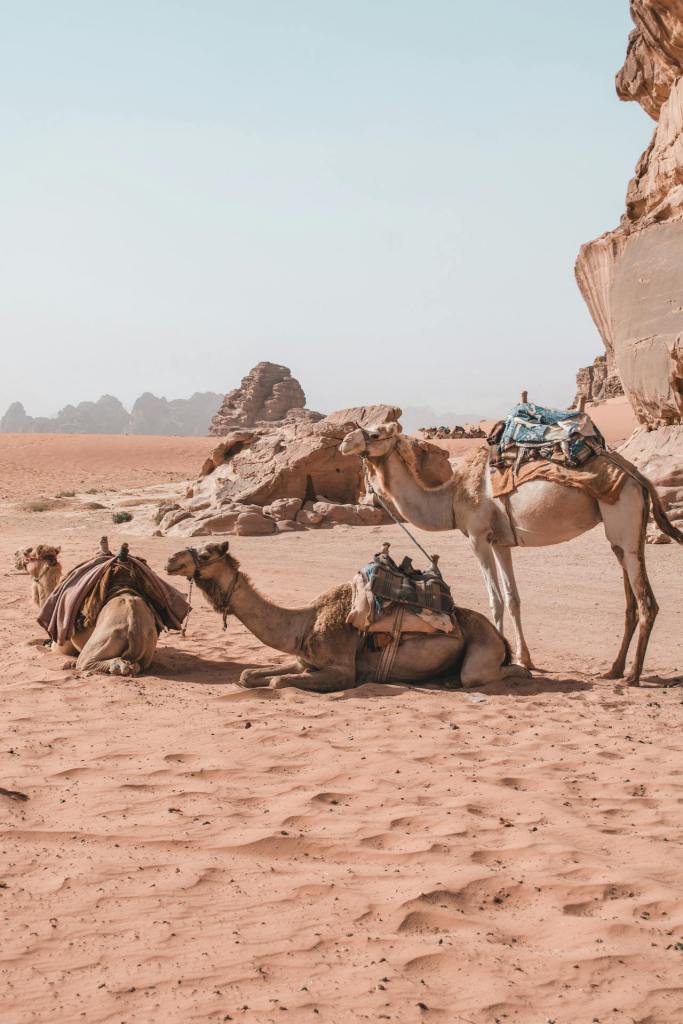
Bedouin communities have been faced with heightening pressure of sedentarisation , i. e. forced to settle in specific areas rather than moving around. This has also taken a toll on their camel herding ability as well as ability to make a living off their traditional habits.
Recently, Bedouin communities have started to lean more into tourism, offering desert tours, stays in desert camps and camel riding experiences. While this provides valuable income to struggling communities, it can also cause serious problems in terms of camel welfare.
Ethical Problems surrounding Camel Rides

Camels face a number of threats in the fast-changing Jordanian environment. Being used in the tourism sector, their well being is often disregarded in favor of camel riding experiences. Camels need appropriate rest in between rides, adequate food and sufficient water supply. Furthermore, the animals need veterinary care, which is rare in remote areas of Jordan.
Especially around tourism hotspots such as Petra, however, tour operators tend to disregard to well being of camels. They often deny them rest in between camels riding experiences and cut back on nutritious food as well as water. This can lead to injuries, illnesses and premature death. Luckily, there is many initiatives for camel welfare in Jordan and the wider Middle East.
Ethical Camel Riding in Jordan

Contemporary initiatives for better camel welfare aim at providing proper education and training in camel herding. The enforce strict animal welfare laws, supporting herding with mobile veterinaries and create sustainable concepts for camel riding.
In Jordan, there is a number of governmental and non-governmental organisations that aim at improving living conditions for domesticated camels in the country.
The most significant initiatives come from the Jordanian Society for the Protection of Animals (JSPA), Royal Society for the Conservation of Nature (RSCN), Animal Health and Veterinary Services Directorate, The Camel Club, Jordan Agricultural Engineers Association.
In Wadi Rum specifically, the Aqaba Exclusive Economic Zone Authority is in charge of ensuring animal welfare among other concerns within the Wadi Rum Protected Area.
Additionally, several independent initiatives aim at providing more ethical camel riding experiences. These take into account the well being of the animal and also allow tourists to gain a deeper understand of the camel and its integral role in Jordanian and Bedouin society.
Is Riding Camels Possible in an Ethical Manner?

So, with all challenges and initiatives in mind, is ethical camel riding realistic? Do camels even like being ridden? Let’s be clear about one thing. A wild camel does not like to be ridden at all.
But, similarly to horses, camels have been domesticated for centuries, making them accustomed to humans riding camels. Their backs can carry heavy loads, even tourists. However, this comes with some “if’s”.
While camels bare with humans riding them and their bodies are naturally built to carry heavy loads, it does not mean they are happy to carry a human at any time. When working with camels, it is important for tour operators and tourists to treat the animals with respect.
This entails proper saddling and proper time limits for camel rides. Camels can only carry heavy loads for limited amounts of time and need adequate rest. Long rides and improper saddling can cause painful wounds. When resting, they need adequate food, water and veterinary care.
In summary, ethical camel riding is possible. While we wouldn’t claim that camels especially love being ridden, they certainly don’t mind being ridden when it occurs under the right circumstances. These include proper saddling, adequate rest times, good nutrition and health care.
5 Tips & Tricks for Your Camel Ride as a Responsible Traveller

So, how to make camel riding ethical? While it is mainly the tour operator’s responsibility to care well for their camels, animals are still being treated badly by some operators. Therefore, it is also your responsibility to pick ethical operators to contribute to animal welfare as a responsible traveler.
Get familiar with our five quintessential tips and tricks to finding ethical camel riding tour offers in Jordan:
- Review operators online: When booking in camel rides in advance, be sure to review offers by reputable operators. Find reputable operators on trusted booking platforms. Check, if an operator mentions their specific commitment to the animal’s welfare. Check for animal welfare certificates such as the Green Key, Travelife Certificate and cooperations with the International Camel Organization. Check reviews for possible bad experiences and descriptions of on-site treatment. Talk directly to owners to learn more about practices. Note: Bedouin rarely posses certificates. Nevertheless, they are generally known to treat their camels well.
- Have an open eye when booking on-site: When securing a camel ride in person, ask to have a look at the animals first. Be wary of came rides around popular tourist attractions. If offered a camel ride right on-site of popular tourist attractions (e.g. right in front of the Treasury of Petra in Jordan, at the Pyramids of Giza in Egypt), you should be extra wary. In hotspots, camels tend to be overworked, plus you have little to no chance of ensuring their welfare.
- Signs of Animal Abuse: Keep an eye out for obvious sores, a sign of the animals being repeatedly hit by the herder. Check for signs of malnutrition. Visible ribs and sunken flanks are clear signs of lacking feeding. If you spot a camel walking with a hunched back or even having trouble walking at all, refrain from soliciting a ride. If a camel appears unusually aggressive, fearful or even lethargic, it might be subject to abuse by the tour operators. If close-by, check their enclosement for cleanliness, feeding and watering stations as well as potential overcrowding.
- Ideal Camel Ride Times: While camels are enduring animals, even they do not have a good time being out in the scorching desert sun for too long. Therefore, opt to ride camels in the early morning or late afternoon to avoid the excessive sun and heat. The ideal times for camel rides are the morning hours before 11 AM and the afternoon hours after 3 PM. Alternatively, you can even opt for night rides, offering a nice panorama of the star-dotted night sky above you.
- Ideal Camel Ride Duration: Ride duration and total saddle time are easy giveaways of the attention given to animal welfare in camel rides, camel treks and camel safaris. Ideally, a camel should not be ridden for more than an hour at a time. During a full-day camel trek, an individual camel should not be ridden for more than two hours a day. For multi-day camel safaris, individual camels should not be used for more than three days at a time.
Fun Fact: Our recommendations might seem a little conservative. After all, camels used to traverse whole desert within weeks and didn’t need as much rest, right? Not quite. The idea of kilometer-long camel caravans walking through the desert for weeks on end is largely a myth.
On caravan treks, cargo would be rotated between several animals during the treks and the camels themselves would be rotated multiple times along the way. Additionally, regular stops at wells and seasonal rivers (wadis) or lakes were made and long breaks at oases were taken with special attention to nutrition and potential health problems.
Conclusion

Let’s wrap this up then. You are planning to ride camels in Jordan? Don’t worry, there is plenty of ethical tour operators in Jordan that allow you to experience camels and be a responsible tourist at the same time.
However, we urge you to do your part, too, and not trust offers blindly. Review your tour operator before booking online or on-site. Take our recommendations for the ethical treatment of camels seriously and try to avoid sub-par operators.
FAQs
Is it painful for camels to be ridden?
Domesticated camels are used to carry heavy loads of cargo or human beings. While they are capable of supporting this weight for a short while, it can be painful for them offer extended periods of time. Moreover, camels need appropriate saddling to carry a human comfortably.
Do camels want to be ridden?
Wild camels do not want to be ridden. Domesticated camels, however, are used to humans and being ridden just like horses. Camel rides are generally accepted as long as the needs of the animal, such as breaks, feeding and medical attention, are met.
Is camel riding humane?
Yes, camel riding is possible in a humane fashion. Camels have been used for transportation in the Middle Eastern countries for centuries. When riding camels, however, you should make sure that the animals are properly cared for.
Are camels comfortable to ride?
Riding a camel is not quite like riding a horse. Sitting high up, riding a camel might feel especially unstable as compared to riding a horse. When riding in proper equipment such as a well-fitted saddle and with a responsible operator that employs well-trained staff, you can expect to have a rather comfortable experience.
Do camels feel pain when ridden?
If ridden in moderation, camels do not experience pain when ridden. Often times, however, operators that offer camel rides around tourist attractions, are known to overuse their animals and subject them to bad treatment including violent abuse, malnutrition and denial of medical attention. Use our tips and tricks to ensure booking your camel safari with responsible operators.


 waditribe.com